By Jennifer Richards, LMT 2026
Understanding the relationship between connective tissue and the upper cervical spine
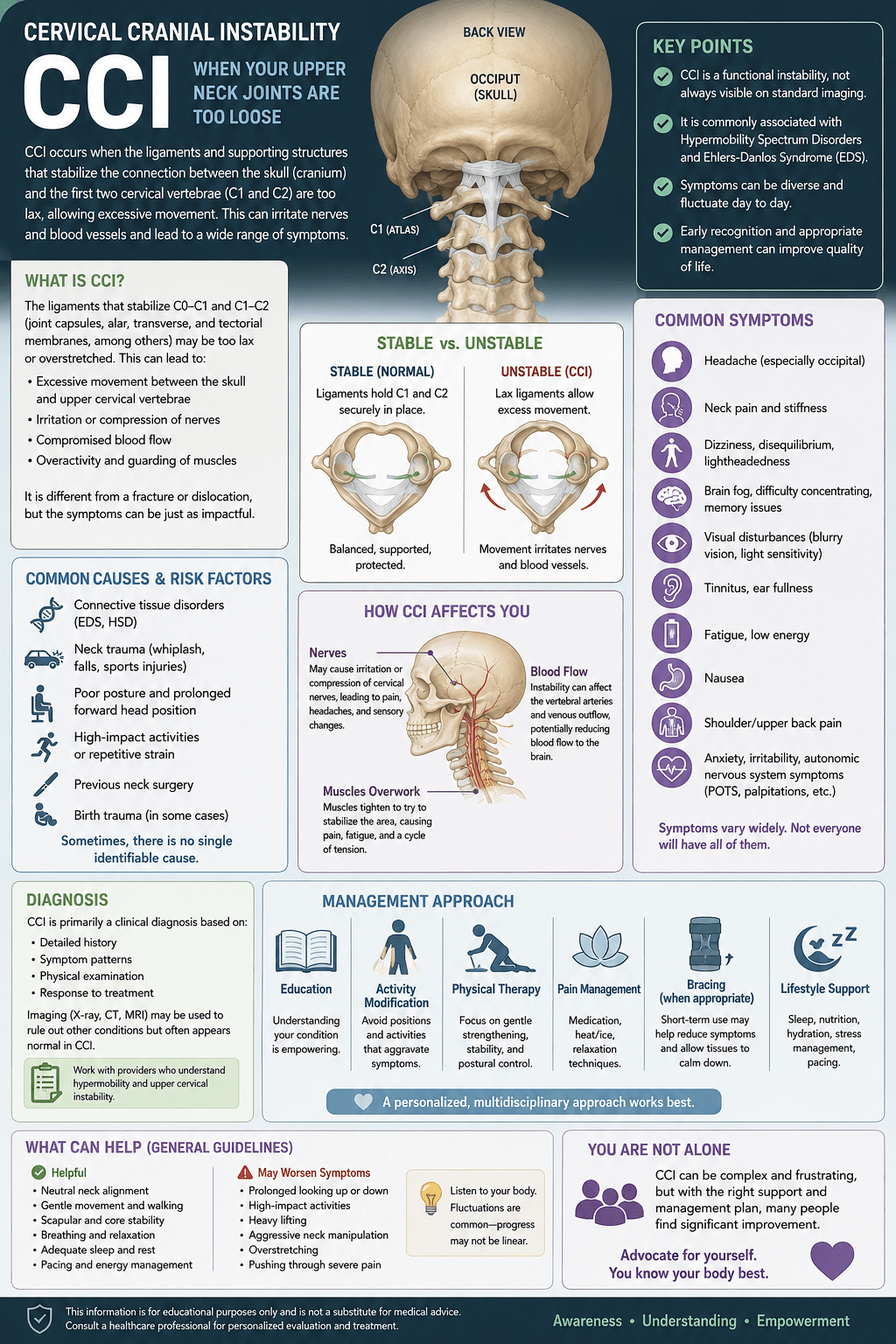
The upper cervical spine is responsible for supporting the head and protecting the brainstem. In individuals with hypermobility or **Ehlers-Danlos Syndrome (EDS), connective tissue differences can sometimes affect the ligaments that stabilize this region.
One condition that may occur in some hypermobile individuals is craniocervical instability (CCI).
Craniocervical instability refers to excessive movement between the skull and the upper cervical vertebrae. This instability can occur when ligaments responsible for stabilizing the upper neck become lax or weakened.
It is important to note that CCI is not present in everyone with hypermobility, but awareness of the condition can help individuals recognize symptoms and seek appropriate evaluation.
The Role of Ligaments in the Upper Cervical Spine
The head rests on two specialized vertebrae:
• Atlas (C1)
• Axis (C2)
These vertebrae allow the head to nod and rotate. They are stabilized by several ligaments that help control movement and protect the brainstem.
In connective tissue disorders, ligaments may be more elastic. When these ligaments do not provide sufficient stability, the skull and upper cervical spine may move more than intended.
This excessive motion can sometimes irritate surrounding structures such as nerves, the spinal cord, or blood vessels.
Symptoms Sometimes Associated with CCI
Symptoms can vary widely depending on the individual and the degree of instability.
Possible symptoms reported by some patients include:
neck pain or pressure at the base of the skull
headaches that worsen when upright
dizziness or balance issues
visual disturbances
brain fog or cognitive fatigue
sensitivity to head movement
Because many of these symptoms overlap with other conditions, proper medical evaluation is important.
Why Hypermobility May Increase Risk
Connective tissue provides stability throughout the body, including in the ligaments of the cervical spine.
In individuals with hypermobility:
ligaments may stretch more easily
joint stability may be reduced
muscles may compensate by tightening
This muscle guarding can sometimes cause chronic neck tension.
For this reason, the neck can be an area of particular sensitivity in hypermobile clients.
Massage Therapy Considerations
Massage therapists working with hypermobile clients should be aware that the upper cervical spine may be more vulnerable in some individuals.
Massage therapists do not diagnose craniocervical instability, but awareness of potential instability can help guide safe bodywork.
Avoid Excessive Neck Movement
Aggressive neck stretching or strong rotational techniques may not be appropriate for hypermobile individuals.
Gentle Cervical Techniques
If working near the neck, gentle techniques that support muscular relaxation without forcing range of motion are generally safer.
Avoid Cervical Traction
Manual traction or pulling on the neck may increase instability in some individuals with ligament laxity.
Support the Head
Proper head support during massage is important to prevent strain on the upper cervical structures.
Encourage Medical Evaluation
If a client reports symptoms such as severe dizziness, neurological changes, or worsening symptoms with neck movement, referral to a healthcare provider may be appropriate.
Why Awareness Matters
Craniocervical instability is one example of how connective tissue disorders can affect areas of the body that are not immediately obvious.
Understanding these connections can help individuals with hypermobility make informed decisions about movement, exercise, and bodywork.
Education also helps practitioners modify techniques to ensure treatments remain safe and supportive.
Remember: neck tightness is indicating that the neck is trying to stabilize loose ligaments and tendons. So, releasing the muscles without a treatment plan for strengthening the muscles would be contraindicated.
The Hypermobility Pain Cycle
Many people with Ehlers-Danlos Syndrome or hypermobility do not experience pain simply because their muscles are “tight.”
Often, the body is attempting to create stability in joints that lack adequate structural support.
This can create a repeating cycle:
- Joint instability or excessive movement
- Muscle guarding and protective tension
- Pain, stiffness, and fatigue
- Aggressive treatment aimed at “releasing” the tension
- Temporary relief
- Rebound guarding as the body attempts to restabilize
- Increased soreness, flares, or worsening symptoms
For many hypermobile clients, the goal should not always be to force muscles to completely relax. Instead, treatment may be more effective when it focuses on:
- nervous system regulation
- improving proprioception
- gentle stabilization
- reducing threat perception
- pacing and recovery
- supporting functional movement
In these cases, muscles are often acting as protective stabilizers rather than simply dysfunctional tissue.
Helpful Resources
For more information about hypermobility and cervical spine involvement, visit The Ehlers-Danlos Society
Neurological and spinal manifestations of EDS
Hypermobile Fitness with Dr Melissa Koehl
Educational Disclaimer
Hypermobility and Ehlers-Danlos Syndrome exist on a spectrum. Every individual experiences connective tissue disorders differently, and not everyone will experience the symptoms or challenges discussed in this article.
The information shared here is intended for educational and awareness purposes only. It is not intended to diagnose, treat, or replace medical advice from a qualified healthcare professional.
Massage therapists do not diagnose medical conditions. If you are experiencing neurological symptoms, persistent neck pain, or concerns related to cervical spine stability, please consult an appropriate healthcare provider.
— Jennifer Richards, LMT


