Jennifer Richards, LMT 2026
Many people assume that individuals with hypermobility are always loose and flexible. In reality, many hypermobile people experience the opposite sensation: stiffness, tight muscles, and restricted movement.
This can be confusing for both clients and massage therapists. Understanding why stiffness occurs in a hypermobile body helps guide safe and effective treatment.
Why Stiffness Happens in Hypermobility
Hypermobility often occurs in connective tissue disorders such as hypermobile Ehlers-Danlos syndrome (hEDS) and hypermobility spectrum disorders (HSD). These conditions affect collagen, the protein that provides structure and support to ligaments, tendons, and other connective tissues.
When collagen is weaker or more elastic than normal:
Ligaments become looser Joints become less stable Muscles must work harder to stabilize the body
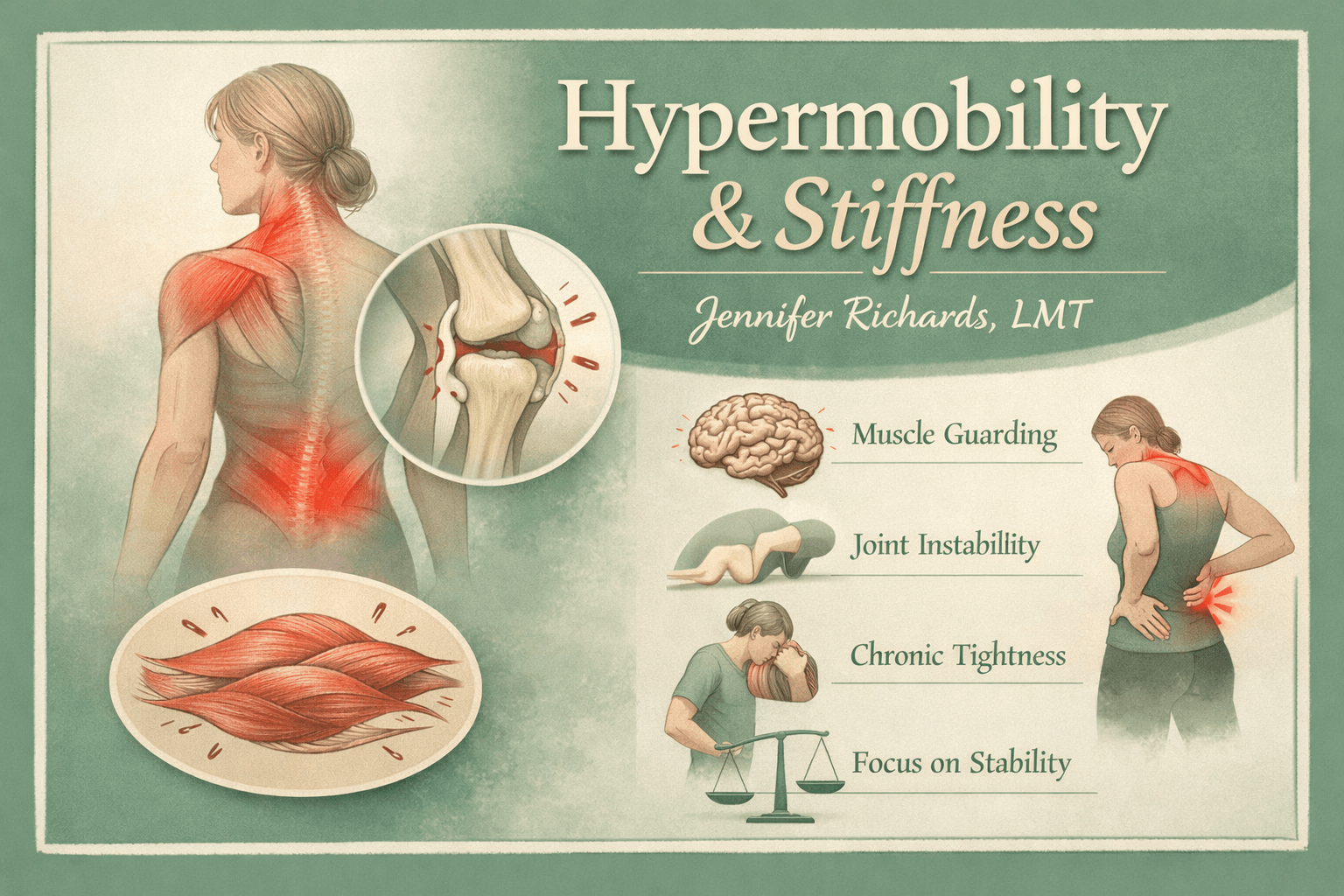
Because the joints are unstable, the muscles surrounding them tighten in an attempt to protect the joint.
This protective response is called muscle guarding. Over time, these muscles become overworked and fatigued, which can lead to chronic stiffness and tension.
In other words:
Loose joints often create tight muscles.
How It Happens (The Biomechanics)
Several mechanisms contribute to stiffness in hypermobile bodies:
1. Joint Instability
Ligaments normally help stabilize joints. In hypermobility, ligaments may be too lax, meaning muscles must constantly compensate.
2. Muscle Overcompensation
Muscles tighten to protect unstable joints. This constant contraction can cause chronic tension and fatigue.
3. Altered Proprioception
Many hypermobile individuals have reduced joint position awareness. The nervous system may increase muscle activity to maintain stability.
4. Protective Nervous System Responses
The brain may increase muscle tension to protect the body from perceived injury, creating persistent stiffness and pain.
How the Client May Feel
Clients with hypermobility-related stiffness often describe sensations such as:
Tight muscles that never seem to relax
Stiffness in the neck, back, or hips
Feeling like their body is working overtime just to stay upright
Limited range of motion in certain areas
Chronic muscle fatigue
Trigger points or tender areas
Morning stiffness or stiffness after activity
Some individuals even feel less flexible than others, despite having hypermobile joints.
Massage Therapy Considerations
Massage therapy can be very beneficial for hypermobile clients, but it must be approached thoughtfully.
Focus on Muscle Support, Not Just Relaxation
Because muscles are working to stabilize joints, the goal is not always to fully “release” tension.
Instead, focus on:
Reducing excessive muscle guarding Supporting healthy movement patterns Improving circulation Decreasing pain
Avoid Excessive Stretching
Hypermobile tissues are already lax. Aggressive stretching may increase joint instability.
Instead:
Use gentle mobilization Encourage controlled strengthening exercises
Moderate Pressure
Deep pressure may feel good temporarily but can sometimes destabilize already vulnerable joints.
Use:
slow myofascial work moderate pressure neuromuscular techniques
Work With the Nervous System
Hypermobile bodies often have heightened nervous system sensitivity.
Helpful approaches include:
slow pace rhythmic techniques diaphragmatic breathing calming the autonomic nervous system
Encourage Stability Between Sessions
Massage therapists may also suggest:
gentle strength training proprioception exercises core stabilization
These strategies help reduce the muscular overcompensation that leads to stiffness.
Reputable Resources
The following organizations provide reliable information about hypermobility and connective tissue disorders:
GeneReviews (NCBI) – Hypermobile Ehlers-Danlos Syndrome
NHS – Joint Hypermobility Syndrome
Cleveland Clinic – Ehlers-Danlos Syndrome
Key Takeaway
Hypermobility does not mean the body is loose everywhere.
In many cases, stiffness is the body’s attempt to create stability.
Understanding this paradox helps massage therapists provide safer, more effective care for hypermobile clients.
Disclaimer
This article is for educational purposes only and is not intended to diagnose, treat, or replace medical care. Individuals with hypermobility disorders such as Ehlers-Danlos syndrome or Hypermobility Spectrum Disorder should consult a qualified healthcare provider for medical advice. Massage therapy should always be adapted to the client’s individual health needs and performed by a licensed professional.

 Tranquil Touch Wellness: Jennifer Richards, LMT
hello, i have not received the webinar link for today’s class.
Best regards,
Maricela
On Mon, Jun 15, 2026 at 10:53 AM Tranquil Touch Wellness: Jennifer
LikeLike
Jennifer Richards, LMT is inviting you to a scheduled Zoom meeting.
Topic: Jennifer Richards, LMT’s Zoom Meeting
Time: Jun 15, 2026 11:45 AM Eastern Time (US and Canada)
Join Zoom Meeting
https://us06web.zoom.us/j/86210496562?pwd=fSFqHHdsZBCxWySPqrTua5DnpXSvJT.1
Meeting chat link
https://us06web.zoom.us/launch/jc/86210496562
View meeting insights with Zoom AI Companion
https://us06web.zoom.us/launch/edl?muid=e586ca73-2bb1-4373-b305-de4c1ce9d508
Meeting ID: 862 1049 6562
Passcode: 993696
—
One tap mobile
+13092053325,,86210496562#,,,,*993696# US
+13126266799,,86210496562#,,,,*993696# US (Chicago)
—
Join by SIP
• 86210496562@zoomcrc.com
Join instructions
https://us06web.zoom.us/meetings/86210496562/invitations?signature=5xVOJvgU6yeUo-3sRGK3nBnphWTVqM20zmGGgNZp5uE
LikeLike