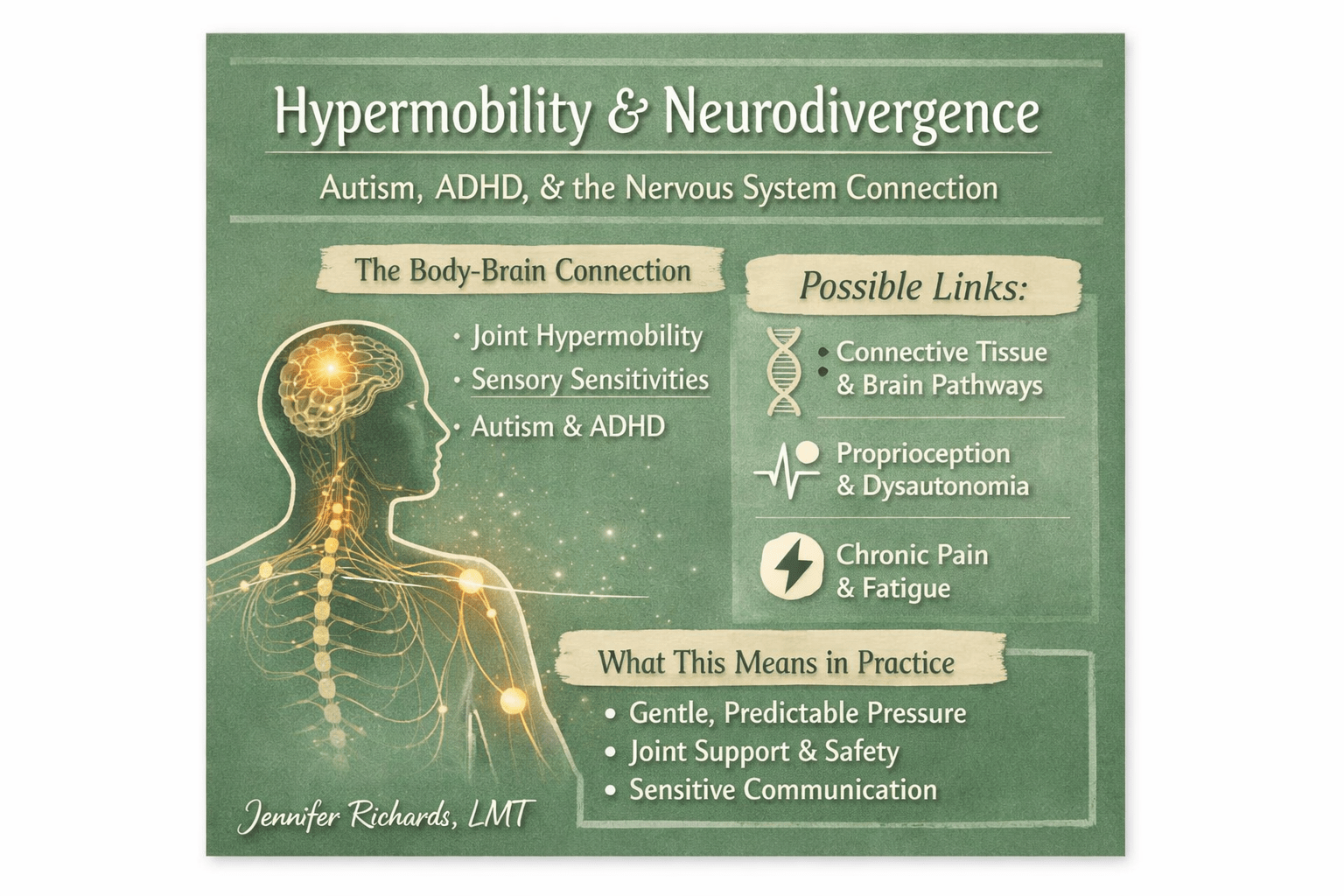
(Autism, ADHD, OCD, and the Nervous System Connection)
By Jennifer Richards, LMT 2026
Hypermobility is often thought of as “just flexible joints,” but for many people, it is far more complex. It affects the nervous system, proprioception, pain processing, and overall body regulation.
In recent years, research has begun to show something many people have already noticed in real life:
👉 There is a meaningful overlap between hypermobility and neurodivergent conditions, especially autism and ADHD.
This doesn’t mean one causes the other—but it does suggest that the body and brain may be more connected than we once realized.
What does the research say?
Studies consistently show that:
Autistic individuals are more likely to have joint hypermobility People with hypermobility disorders (like HSD or hEDS) are more likely to have autism or autistic traits ADHD is also associated with hypermobility in both children and adults Anxiety is very common in hypermobile populations
Some studies suggest that:
Around 20–30% of autistic individuals may also have joint hypermobility The likelihood of hypermobility may be 3–5 times higher in autistic individuals
When it comes to OCD, the evidence is less clear. There may be overlap in some individuals, but current research does not show the same consistent connection seen with autism and ADHD.
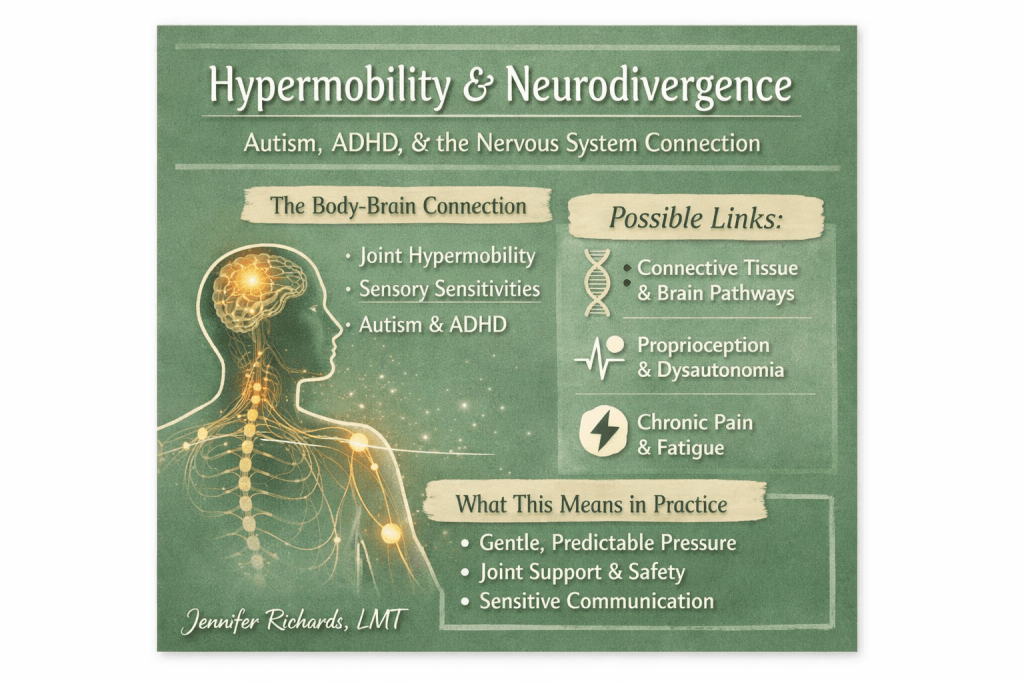
Why might this happen?
We don’t have one clear answer yet—but several strong theories exist.
1. The connective tissue–brain connection
Connective tissue is everywhere—not just in joints:
Around nerves
In blood vessels
In the gut
Throughout the fascia system
If connective tissue behaves differently, it may influence how the body:
Processes sensory input
Regulates blood flow
Communicates between body and brain
2. Proprioception and body awareness
Many hypermobile individuals have reduced proprioception (awareness of where the body is in space).
This can lead to:
Clumsiness
Frequent injury
Constant muscle tension (the body trying to stabilize itself)
Now layer that with neurodivergence, where sensory processing may already be different—and you can see how the experience becomes amplified.
3. The nervous system and dysautonomia
Hypermobility is often associated with:
Dysautonomia (like POTS)
Fatigue
Dizziness
Temperature regulation issues
These symptoms can feel like:
Anxiety
Overwhelm
Burnout
“Crashing” after activity
For someone with autism or ADHD, this adds another layer of challenge:
👉 The body itself can feel unpredictable.
4. Chronic pain and sensory load
Pain changes everything.
When the body is constantly dealing with:
Micro-instability
Muscle guarding
Inflammation
Fatigue
…it increases the overall sensory load on the nervous system.
This can contribute to:
Difficulty focusing
Irritability
Shutdown or overwhelm
Increased need for control or routine
What might this look like?
Someone with both hypermobility and neurodivergence may experience:
Muscles that feel tight—but joints that are unstable
Sensitivity to touch, pressure, light, or sound
Difficulty with coordination or body awareness
Fatigue that doesn’t match activity level
Anxiety-like symptoms driven by the body
A feeling of “my body doesn’t cooperate with me”
Massage Therapy Considerations
This is where things really matter.
A hypermobile, neurodivergent client is not just a musculoskeletal case—they are a nervous system case.
1. Pressure is not the goal—regulation is
Tight does not always mean “needs deep pressure.”
In hypermobile bodies:
Muscles are often tight because they are stabilizing unstable joints Deep or aggressive work can make the body feel less safe, not better
👉 Slow, intentional, and moderate pressure is often more effective.
2. Predictability matters
For many autistic or ADHD clients:
Unexpected touch can be stressful
Transitions can be dysregulating
Helpful strategies:
Explain what you’re doing before you do it
Keep a predictable flow
Avoid sudden changes in pressure or pace
3. Sensory environment is part of the treatment
Consider:
Lighting Music (or silence)
Temperature
Scents
What is relaxing for one person may be overwhelming for another.
4. Joint safety is essential
Hypermobile clients may:
Sit or lie in positions that look comfortable—but aren’t safe
Not feel instability until later
Always:
Support joints with bolsters
Avoid end-range positioning
Watch for subtle signs of guarding
5. Communication must be individualized
Some clients may:
Under-report pain
Overwhelm quickly
Struggle to describe sensations
Check in clearly and specifically:
“How does this pressure feel?” “Do you feel supported here?” “Would you like more or less input?”
The Big Picture
This connection between hypermobility and neurodivergence is still being explored—but one thing is already clear:
👉 The body and nervous system are deeply connected.
When we understand that:
Pain Sensory processing
Fatigue
Emotional regulation
…are all part of the same system, we become better practitioners—and better advocates for our clients.
Reputable Sources
PubMed: Autism and Joint Hypermobility Systematic Review
Frontiers in Psychiatry: Autism and Generalized Joint Hypermobility
Frontiers: Neurodivergence, Hypermobility, Dysautonomia, and Pain
PubMed: ADHD and Joint Hypermobility Review
PMC: HSD/hEDS and Neurodevelopmental Conditions in Children
Disclaimer
This article is for educational purposes only and is not intended to diagnose, treat, or replace medical or mental health care. The relationship between hypermobility and neurodivergent conditions such as autism and ADHD is an emerging area of research and is not yet fully understood. Not all individuals with hypermobility are neurodivergent, and not all neurodivergent individuals are hypermobile. Massage therapists should remain within their scope of practice and adapt care based on each client’s individual presentation, comfort, and medical history.

 Tranquil Touch Wellness: Jennifer Richards, LMT