By Jennifer Richards 2026
As a massage therapist, I often see clients who don’t fit neatly into one category. They come in with pain—but also fatigue. Or headaches—but also digestive issues. Or anxiety—but also joint instability.
These are not random symptoms.
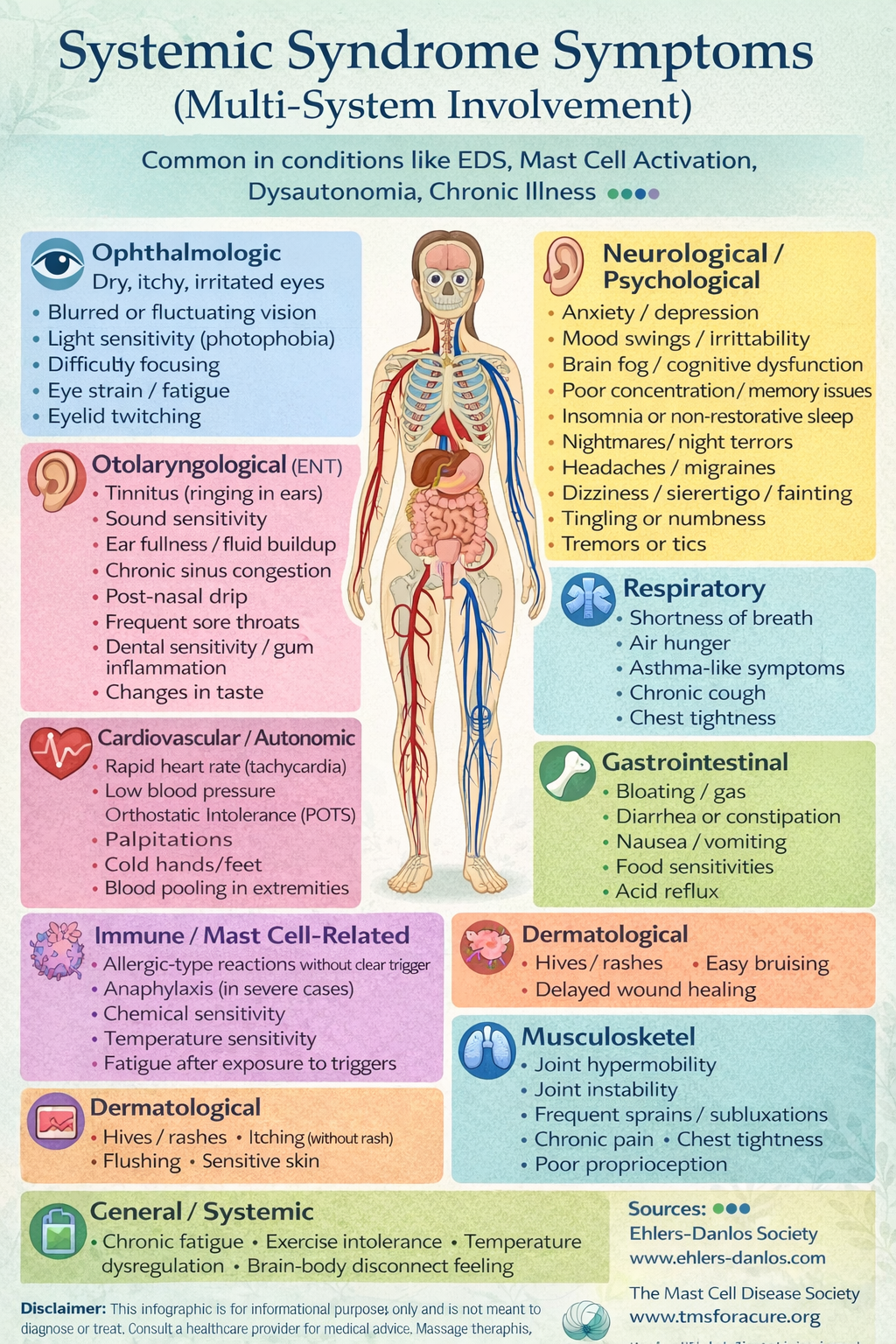
They are often part of a multi-system pattern, commonly seen in conditions like:
Hypermobility spectrum disorders / Ehlers-Danlos Syndrome (EDS)
Mast Cell Activation Syndrome (MCAS)
Dysautonomia (including POTS)
These conditions frequently overlap—and when they do, the body can feel unpredictable, overwhelming, and misunderstood.
Why So Many Symptoms?
The body is not a collection of separate systems—it’s an integrated network.
When one system becomes dysregulated, others often follow:
Connective tissue (EDS) affects joints, blood vessels, and organs
Nervous system (dysautonomia) affects heart rate, blood pressure, digestion
Immune system (mast cells) affects inflammation, allergies, skin, and more
This is why someone may experience:
Joint instability and GI issues
Anxiety and heart palpitations
Skin reactions and brain fog
The Overlap Matters
Research increasingly supports this triad:
Postural Orthostatic Tachycardia Syndrome
These conditions often coexist and amplify each other.
Massage Therapy Considerations
This is where your work becomes incredibly powerful—but also requires nuance.
What Helps
Gentle, slow techniques
Lymphatic support
Nervous system regulation (parasympathetic activation)
Myofascial work (with caution)
Client-led pressure and positioning
What to Be Careful With
Deep pressure on unstable joints
Overstretching (especially in hypermobile clients)
Rapid positional changes (can trigger dizziness)
Strong scents (may trigger mast cell reactions)
Long sessions without breaks
Clinical Insight
Many hypermobile clients present with:
Tight muscles + loose joints
The tightness is protective, not pathological
Your job is not to “loosen everything”
It’s to support stability and calm the system
The Bigger Picture
Clients with these patterns are often told:
“It’s just anxiety” “Your tests are normal” “You’re fine”
But their experience is real.
Understanding multi-system involvement allows us to:
Validate their experience
Adapt our treatment approach
Avoid harm
Become part of their support system
References & Further Reading
Ehlers-Danlos Society https://www.ehlers-danlos.com
Dysautonomia International https://www.dysautonomiainternational.org
The Mast Cell Disease Society https://tmsforacure.org Afrin LB. Never Bet Against Occam: Mast Cell Activation Disease Hakim A, Grahame R. Hypermobility research publications
Disclaimer
This content is for educational purposes only and is not intended to diagnose, treat, or replace medical care. Always refer clients to qualified healthcare providers for diagnosis and management of medical conditions. Massage therapists should work within their scope of practice and modify techniques based on individual client needs and responses.
Invitation
If you recognize yourself or your clients in this pattern, you’re not alone—and you’re not imagining it.
I’d love to hear your experience or answer questions. These conversations are how we move the profession forward.

 Tranquil Touch Wellness: Jennifer Richards, LMT