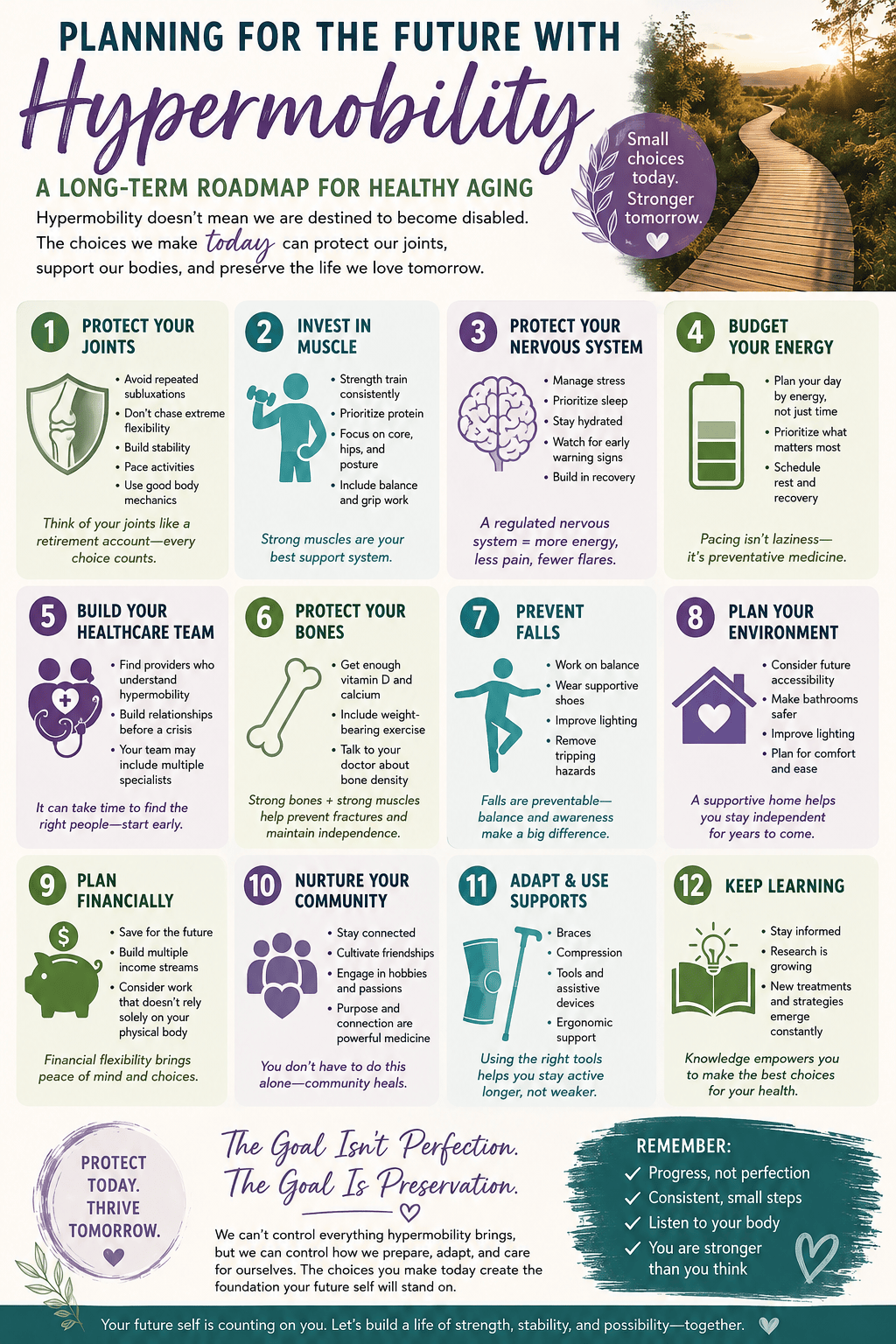
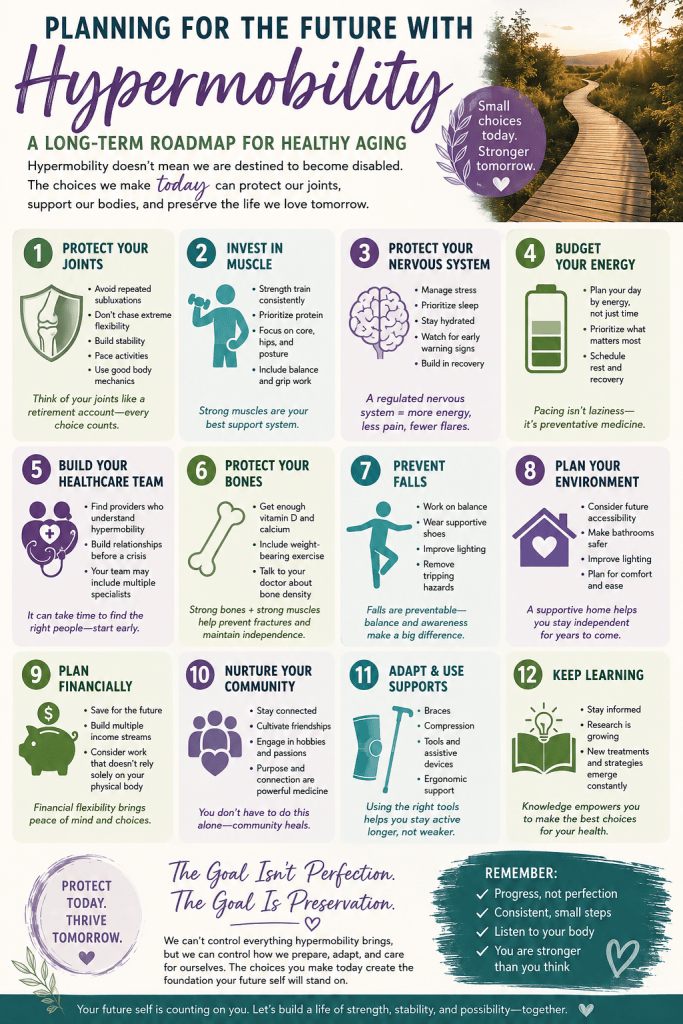
A Long-Term Roadmap for Healthy Aging
By Jennifer Richards, LMT
When you’re first diagnosed with hypermobility—or even when you begin to suspect you have it—most of the conversation revolves around symptoms.
How do I manage pain?
How do I stop subluxations?
Why am I so tired?
What causes these flares?
These are important questions, but eventually another one begins to surface:
What does the future look like?
As someone living with hypermobility myself, I have found myself asking a different question:
How can I help my 75-year-old self have the best quality of life possible?
That shift in perspective changes everything.
Instead of focusing only on today’s symptoms, we begin making decisions that protect tomorrow’s function.
Think Like You’re Investing in Retirement
Most of us understand saving money for retirement.
Every deposit we make today benefits our future selves.
Our bodies work in much the same way.
Every healthy habit is a deposit.
Every preventable injury is a withdrawal.
Hypermobility doesn’t mean we are destined to become disabled. However, because our connective tissue provides less passive stability, we often depend more heavily on our muscles, nervous system, and movement habits to keep us functioning well.
The goal isn’t perfection.
The goal is preserving function.
Build Strength, Not Just Flexibility
Many hypermobile people spent years being complimented on their flexibility.
Ironically, flexibility is rarely what we need more of.
Instead, we need stability.
Our muscles become the body’s “external ligaments,” helping support joints that naturally move beyond their ideal range.
Strength training doesn’t have to mean lifting heavy weights or becoming a bodybuilder.
It means developing functional strength that supports everyday life:
- Strong hips
- Strong core muscles
- Healthy shoulders
- Good grip strength
- Balance and coordination
The stronger your muscles, the more they can help protect your joints throughout life.
Protect Your Nervous System
Many people with hypermobility also experience conditions such as dysautonomia, migraine, mast cell activation, chronic pain, fatigue, or sensory overload.
For many of us, managing our nervous system is just as important as managing our joints.
Pay attention to the factors that commonly trigger flares:
- Dehydration
- Overheating
- Sleep deprivation
- Emotional stress
- Illness
- Overexertion
- Poor recovery between activities
Sometimes the best treatment isn’t pushing harder.
Sometimes it’s recognizing the warning signs before your body forces you to stop.
Learn to Budget Your Energy
Most healthy adults schedule their lives according to time.
Many people with hypermobility have to schedule according to energy.
Some days you may have enough energy for work, exercise, and dinner with friends.
Other days, simply getting through work may use your entire “energy budget.”
Learning to pace yourself is not laziness.
It is a legitimate medical strategy that helps prevent major flares and supports long-term function.
Prevent Injuries Before They Happen
Every injury matters.
Repeated sprains, joint instability, falls, and subluxations can accumulate over decades.
Simple habits make a difference:
- Improve balance.
- Wear supportive footwear.
- Avoid repeatedly pushing joints to their maximum range.
- Lift with good body mechanics.
- Ask for help when needed.
Protecting your joints today may reduce arthritis and chronic pain later in life.
Keep Moving
Movement is medicine.
The challenge is finding the right amount.
Complete inactivity weakens muscles.
Too much activity can trigger flares.
The goal is consistent, sustainable movement.
Many people with hypermobility do well with activities such as:
- Walking
- Swimming
- Pilates
- Tai Chi
- Gentle yoga (without forcing end-range stretching)
- Supervised strength training
The best exercise is often the one your body can tolerate consistently.
Build Your Healthcare Team Before You Need One
One of the biggest mistakes many people make is waiting until they are in crisis before searching for specialists.
Instead, slowly build relationships with healthcare professionals who understand connective tissue disorders.
Your team may include:
- Primary care physician
- Physical therapist knowledgeable about hypermobility
- Cardiologist (if dysautonomia is present)
- Allergist or immunologist (if mast cell activation is suspected)
- Pelvic floor therapist
- Mental health professional
- Massage therapist familiar with hypermobility
Finding knowledgeable providers often takes time.
Starting before a crisis can reduce stress later.
Protect Your Bones
As we age, muscle mass naturally declines, and bone density may decrease, especially after menopause.
Talk with your healthcare provider about whether you would benefit from:
- Bone density screening
- Vitamin D testing
- Adequate calcium intake
- Weight-bearing exercise
- Resistance training
Strong muscles and healthy bones work together to reduce the risk of falls and fractures.
Plan Your Home for the Future
This doesn’t mean expecting disability.
It means making thoughtful choices that support independence.
Consider questions such as:
- Would this home work if climbing stairs became difficult?
- Is the bathroom safe?
- Could grab bars be added if needed?
- Is lighting adequate?
- Are there tripping hazards?
Planning ahead often means you’ll never need many of these modifications.
Think Beyond Your Current Career
Many people with hypermobility work physically demanding jobs.
Ask yourself:
“If my body changes, how else can I continue doing meaningful work?”
Perhaps through:
- Teaching
- Writing
- Consulting
- Public speaking
- Online education
- Mentoring
Building additional skills today can provide flexibility later.
Protect Your Relationships
Health is about more than joints.
Stay connected to family, friends, colleagues, hobbies, and your community.
Research consistently shows that meaningful social connections contribute to better physical and mental health as we age.
Purpose matters.
Connection matters.
Accept That Adaptation Is Strength
There may come a day when you benefit from:
- Compression garments
- Braces
- Trekking poles
- Ergonomic tools
- Different shoes
- Assistive devices
These are not signs of failure.
They are tools that help preserve independence.
Using the right support at the right time often allows people to remain active far longer.
Looking Toward Tomorrow
When I think about my future, I don’t ask whether I’ll still be as flexible or whether my pain will completely disappear.
I ask a different question:
Will I still be able to teach?
Will I still be able to write?
Will I still be able to help people understand hypermobility?
For me, that is success.
Living well with hypermobility isn’t about eliminating every symptom.
It’s about preserving the ability to continue living a meaningful life.
The choices we make today become the foundation our future selves stand on.
Perhaps the greatest gift we can give ourselves isn’t another stretch, another supplement, or another gadget.
Perhaps it’s making decisions today that allow us to keep doing what we love for years to come.
Our future selves are counting on us.
Considerations for Massage Therapists
Massage therapists living with hypermobility face unique challenges because our careers rely on our bodies.
Long-term career planning should include:
- Practicing excellent body mechanics.
- Avoiding excessive thumb and wrist strain.
- Varying techniques to reduce repetitive stress.
- Scheduling adequate recovery time between clients.
- Building additional income streams such as teaching, writing, consulting, or continuing education.
- Seeking treatment for injuries early rather than working through pain.
Protecting yourself allows you to continue helping others.
Medical Disclaimer
This article is intended for educational purposes only and should not replace medical advice, diagnosis, or treatment from a qualified healthcare professional. Hypermobility exists on a spectrum, and every individual has different needs. Always consult your healthcare provider before beginning a new exercise program, changing medications, or making significant health decisions.
References
- The International Consortium on the Ehlers-Danlos Syndromes. The 2017 International Classification of the Ehlers-Danlos Syndromes.
- Castori M, et al. Management of hypermobile Ehlers-Danlos syndrome and hypermobility spectrum disorders.
- The Ehlers-Danlos Society. Educational resources on healthy aging, rehabilitation, and multidisciplinary care.
- American College of Sports Medicine (ACSM). Guidelines for Exercise Testing and Prescription.
- National Institute on Aging. Healthy Aging, Strength Training, Balance, and Fall Prevention.
- Centers for Disease Control and Prevention (CDC). Older Adult Fall Prevention Resources.

 Tranquil Touch Wellness: Jennifer Richards, LMT