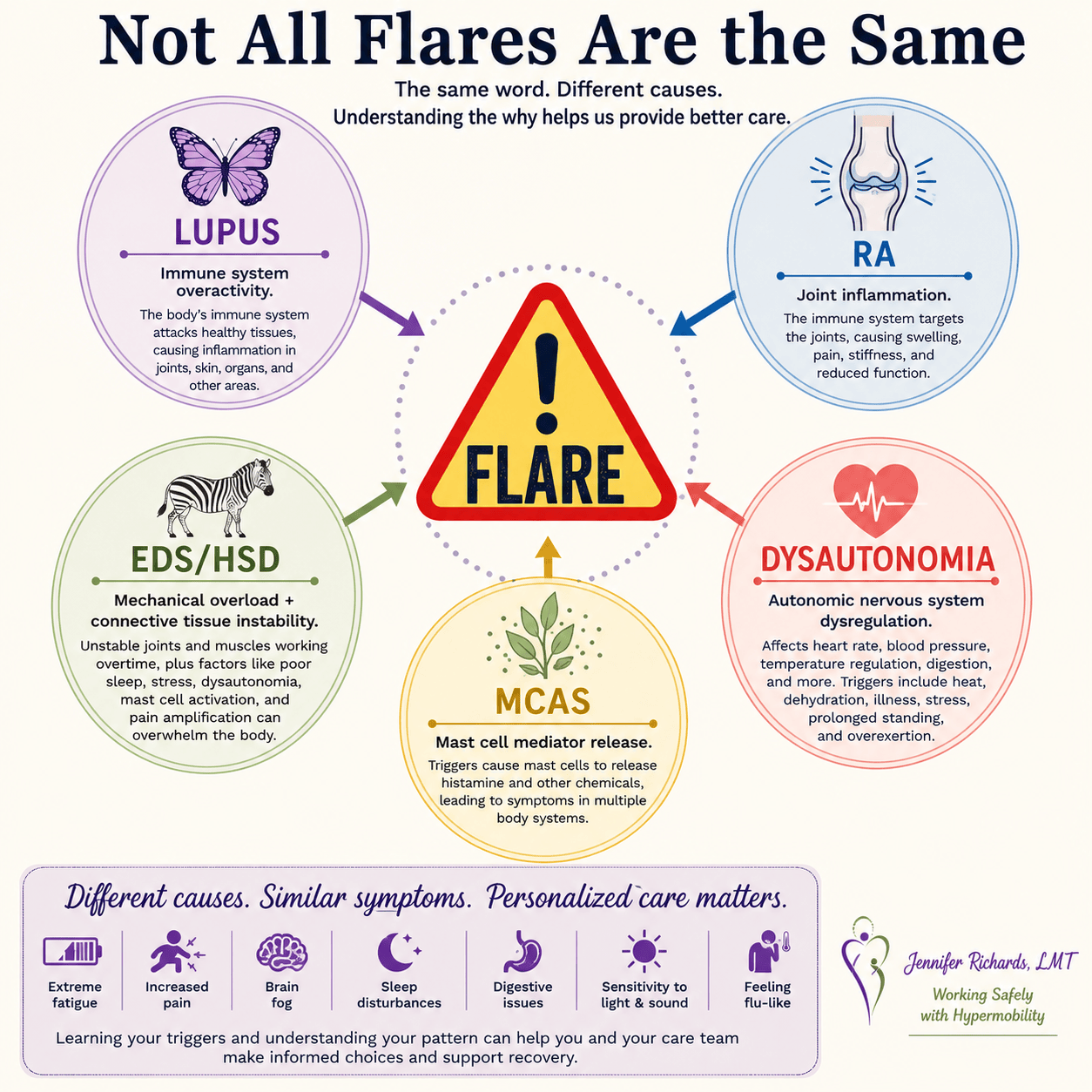
By Jennifer Richards, LMT
“I think I’m having a flare.”
If you spend time in communities for Ehlers-Danlos syndrome (EDS), hypermobility spectrum disorders (HSD), lupus, rheumatoid arthritis (RA), multiple sclerosis (MS), mast cell activation syndrome (MCAS), or myalgic encephalomyelitis/chronic fatigue syndrome (ME/CFS), you’ll hear that phrase often.
But what exactly is a flare?
Interestingly, a flare is not a diagnosis. It is a temporary worsening of symptoms beyond a person’s usual baseline.
The important question isn’t whether someone is flaring.
The important question is why.
A Flare Is Your Body Saying, “I Can’t Compensate Right Now.”
Our bodies constantly adapt to physical, emotional, and environmental stress.
Usually they do this remarkably well.
Sometimes, however, those systems become overwhelmed. When that happens, symptoms can temporarily intensify.
This period of increased symptoms is what we call a flare.
Think of it like driving a car up a steep mountain.
The engine may run perfectly under normal conditions. But if you keep adding weight, increase the incline, and turn on the air conditioner on a hot day, eventually the engine begins to struggle.
Different medical conditions have different “engines,” but they can all become overloaded.
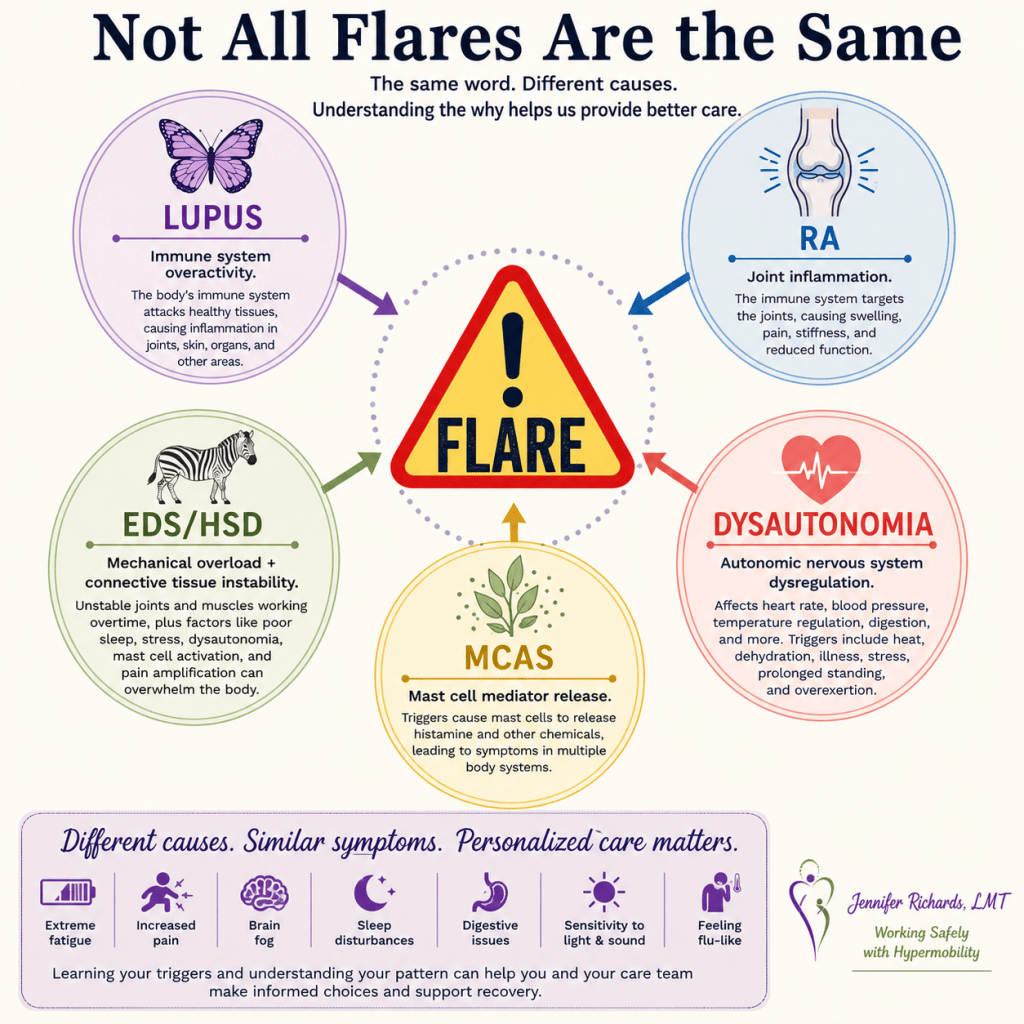
Lupus: An Immune System Flare
In lupus, the immune system becomes overactive and mistakenly attacks healthy tissues.
During a flare, inflammation may increase throughout the body, affecting joints, skin, kidneys, lungs, the heart, or other organs.
Symptoms may include:
- Joint pain and swelling
- Fatigue
- Fever
- Skin rashes
- Mouth ulcers
- Organ inflammation
Because lupus is an autoimmune disease, treatment often focuses on reducing inflammation and calming the immune response under the guidance of a physician.
Rheumatoid Arthritis: Joint Inflammation
RA flares are also driven by immune system activity, but the inflammation primarily targets the joints.
People often experience:
- Warm, swollen joints
- Morning stiffness
- Fatigue
- Increased pain
- Reduced function
Again, the underlying issue is immune-mediated inflammation.
Hypermobility (EDS/HSD): A Different Kind of Flare
This is where things become especially interesting.
People with EDS or HSD absolutely experience flares.
However, current research suggests these flares are often not caused by autoimmune inflammation.
Instead, they may result from a combination of factors, including:
- Mechanical overload from unstable joints
- Muscles working overtime to create stability
- Dysautonomia
- Poor sleep
- Accumulated physical activity
- Emotional stress
- Mast cell activation (in some individuals)
- Central pain sensitization
Instead of one system malfunctioning, several body systems may become overwhelmed at the same time.
Dysautonomia Can Create a Flare Too
The autonomic nervous system controls many automatic functions including:
- Heart rate
- Blood pressure
- Temperature regulation
- Digestion
- Sweating
- Breathing
When that system becomes dysregulated, symptoms may suddenly worsen.
People often describe:
- Rapid heart rate
- Lightheadedness
- Fatigue
- Brain fog
- Exercise intolerance
- Heat intolerance
- Gastrointestinal symptoms
These episodes may be triggered by heat, dehydration, illness, prolonged standing, or emotional stress.
Mast Cell Activation Can Add Another Layer
For individuals with MCAS, certain triggers may activate mast cells, releasing chemicals such as histamine.
Symptoms may include:
- Flushing
- Itching
- Hives
- Digestive symptoms
- Brain fog
- Fatigue
- Increased pain
For some people with hypermobility, dysautonomia and mast cell activation appear to overlap, although researchers are still working to better understand these relationships.
Why Do So Many Conditions Feel Similar?
Here’s the fascinating part.
Whether the problem begins in the immune system, connective tissue, autonomic nervous system, or mast cells, the body has a limited number of ways to signal distress.
Many flares share common symptoms:
- Extreme fatigue
- Increased pain
- Brain fog
- Poor concentration
- Sleep disturbances
- Headaches
- Dizziness
- Digestive problems
- Sensitivity to light, sound, or touch
- Feeling “like you have the flu”
The symptoms overlap because the immune, nervous, endocrine, and pain-processing systems constantly communicate with one another.
Common Flare Triggers
While triggers vary between individuals, many people notice patterns such as:
- Illness
- Surgery
- Emotional stress
- Poor sleep
- Overexertion
- Heat or cold
- Hormonal changes
- Dehydration
- Changes in medication
- Major life events
Learning your own triggers is often one of the most valuable parts of long-term symptom management.
What Can Massage Therapists Learn From This?
One difficult massage does not necessarily mean the treatment was inappropriate.
Sometimes a client arrives already approaching their threshold.
For hypermobile clients especially, therapists should recognize that today’s presentation may not match last month’s.
During a flare, consider:
- Reducing pressure
- Limiting aggressive stretching
- Avoiding excessive joint traction
- Prioritizing comfort over “fixing”
- Encouraging pacing and recovery
- Monitoring for signs of autonomic distress such as dizziness, nausea, sweating, or unusual fatigue
Sometimes the most therapeutic session is the gentlest one.
My Perspective
As both a massage therapist and someone living with hypermobility, dysautonomia, and mast cell activation, I’ve noticed something.
A flare doesn’t necessarily mean I’ve done something wrong.
Sometimes it means my body has simply reached its current limit.
That realization has changed how I think about recovery.
Instead of asking:
“What did I do wrong?”
I now ask:
“What systems might be asking for support today?”
That shift encourages curiosity instead of self-blame.
Final Thoughts
A flare is not simply “having a bad day.”
It is your body’s way of communicating that its normal ability to compensate has been temporarily exceeded.
Understanding why you’re flaring can help guide more appropriate treatment, whether that means addressing inflammation, improving hydration, modifying activity, managing stress, improving sleep, or simply allowing your body time to recover.
While the word “flare” is shared by many different conditions, the biology behind it can be very different.
Recognizing those differences is one more step toward providing better care—and better understanding—for everyone living with chronic illness.
Medical Disclaimer
This article is for educational purposes only and should not be considered medical advice. If you experience new, severe, or worsening symptoms, consult your physician or other qualified healthcare professional. Massage therapists do not diagnose medical conditions but can recognize patterns, adapt treatment appropriately, and refer clients when necessary.
References
- The Ehlers-Danlos Society. Hypermobile EDS and Hypermobility Spectrum Disorders educational resources.
- Lupus Foundation of America. Understanding lupus flares.
- Arthritis Foundation. Rheumatoid arthritis flare information.
- Dysautonomia International. Dysautonomia educational resources.
- Centers for Disease Control and Prevention. Myalgic encephalomyelitis/chronic fatigue syndrome.
- American Massage Therapy Association. Massage therapy considerations for clients with chronic conditions.


