By Jennifer Richards, LMT
A client with hypermobility may arrive for a massage with a surprisingly long medication list.
One medication may be for pain. Another may control heart rate. Another raises blood pressure. One may calm histamine-related symptoms. Another may address gastrointestinal problems. And increasingly, some clients may be taking medications such as GLP-1 receptor agonists or low-dose naltrexone (LDN).
This doesn’t mean there is a standard “hypermobility medication regimen.”
There isn’t.
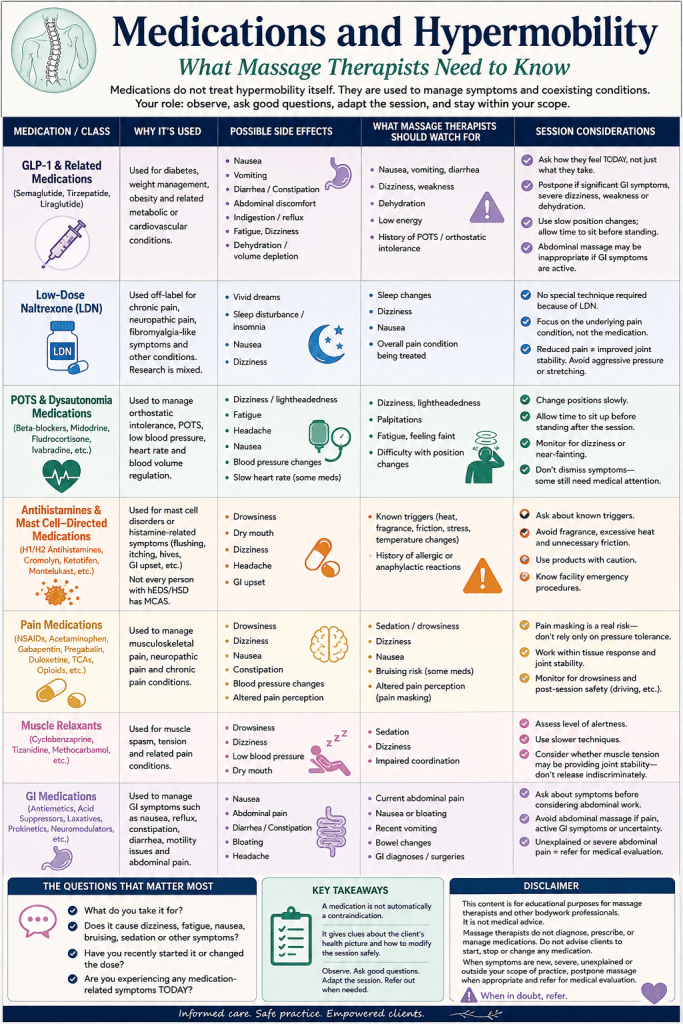
Hypermobile Ehlers-Danlos syndrome (hEDS) and hypermobility spectrum disorders (HSD) are connective-tissue conditions, and medication does not make the connective tissue less hypermobile. Instead, medications are generally used to manage symptoms and coexisting conditions. These can include chronic pain, neuropathic pain, dysautonomia/POTS, gastrointestinal dysfunction and—in appropriately diagnosed patients—mast-cell disorders. (NCBI)
For massage therapists, the goal isn’t to decide whether a medication is appropriate.
Our job is to understand how that medication—or the condition it is treating—might affect the massage session.
1. GLP-1 and Related Medications
Examples include:
- Semaglutide
- Tirzepatide
- Liraglutide
GLP-1 receptor agonists, and related medications such as tirzepatide, are used for conditions including diabetes, obesity and weight management. Some semaglutide formulations also have cardiovascular and other approved indications. (FDA Access Data)
They are not treatments for hypermobility itself.
However, massage therapists are increasingly likely to encounter clients taking them.
Why does this matter?
These medications affect the gastrointestinal system and can delay gastric emptying.
Common adverse effects of semaglutide include:
- Nausea
- Vomiting
- Diarrhea
- Constipation
- Abdominal discomfort
- Fatigue
- Dizziness
- Indigestion and reflux
Significant vomiting or diarrhea can also contribute to dehydration and volume depletion. (FDA Access Data)
That becomes particularly interesting in a hypermobile client who already experiences orthostatic intolerance or POTS.
Massage considerations
Ask how the client feels today, not merely whether they take a GLP-1.
A client experiencing significant nausea, vomiting, diarrhea, dizziness, weakness or dehydration is probably not an ideal candidate for a routine massage that day.
Be cautious with rapid position changes. Allow the client to sit before standing after the session, particularly if they already experience orthostatic symptoms.
Abdominal massage may also be inappropriate or uncomfortable in a client experiencing significant GI symptoms, bloating, constipation or abdominal pain.
A massage therapist should not automatically attribute new or severe abdominal symptoms to a medication. Severe or unusual symptoms warrant medical evaluation rather than massage.
2. Low-Dose Naltrexone (LDN)
LDN has become increasingly discussed in chronic-pain communities.
Naltrexone was originally developed and approved at substantially higher doses for opioid and alcohol use disorders. “Low-dose naltrexone” refers to much smaller doses used off-label for conditions involving chronic or centralized pain.
Proposed mechanisms include effects on opioid receptors and neuroimmune signaling.
Research remains mixed.
Some reviews have reported promising results for certain chronic pain conditions, while a 2024 systematic review of randomized trials found insufficient evidence that LDN meaningfully reduced chronic pain across the conditions studied. More recent reviews continue to describe the evidence as limited and heterogeneous. (PubMed Central (PMC))
In other words:
LDN is interesting. It is not a proven treatment for hEDS or HSD.
Possible side effects
LDN is generally reported as well tolerated, but adverse effects may include:
- Vivid dreams
- Sleep disturbance or insomnia
- Nausea
- Dizziness
Massage considerations
There is no special massage technique required simply because someone takes LDN.
Instead, determine why the client takes it.
If the answer is chronic widespread pain, fibromyalgia-like symptoms or neuropathic pain, that underlying pain condition may be much more relevant to treatment planning than the medication itself.
Remember that reduced pain does not equal improved joint stability.
A client who feels better may tolerate more pressure—but that does not mean deeper pressure, stretching or aggressive joint mobilization has suddenly become appropriate.
3. Medications for POTS and Dysautonomia
Some people with hEDS/HSD also have orthostatic intolerance or POTS.
Medications that may be prescribed include:
- Beta-blockers
- Midodrine
- Fludrocortisone
- Ivabradine
- Other medications chosen according to the individual’s presentation
GeneReviews specifically notes these among pharmacologic approaches sometimes used for POTS and neurally mediated hypotension in hEDS. (NCBI)
These medications may be used to influence heart rate, blood pressure, blood volume or vascular tone.
What should the massage therapist watch for?
This is where positioning becomes especially important.
Watch for:
- Lightheadedness
- Dizziness
- Weakness
- Palpitations
- Unusual fatigue
- Feeling faint
- Difficulty tolerating standing after lying down
Never rush a dysautonomic client off the table.
After a supine or prone session, allow the client time to sit upright and assess how they feel before standing.
If dizziness develops, don’t assume, “That’s just their POTS.”
Symptoms still deserve attention.
4. Antihistamines and Mast-Cell-Directed Medications
Some hypermobile clients are diagnosed with mast-cell disorders or are being evaluated for symptoms such as flushing, itching, hives and episodic multisystem reactions.
It is important not to assume that every person with hEDS/HSD has MCAS. Current expert guidance recognizes overlapping symptoms while emphasizing that routine testing for MCAS in everyone with hEDS/HSD is not supported by existing evidence. (PubMed)
When mast-cell disease is appropriately diagnosed, treatment may include:
- H1 antihistamines
- H2 antihistamines
- Cromolyn
- Ketotifen
- Montelukast
- Other specialist-directed therapies
(NCBI)
Massage considerations
Ask about known triggers.
For some clients, triggers can include:
- Heat
- Fragrance
- Certain topical products
- Friction
- Temperature changes
- Stress
Mechanical stimuli such as friction and temperature changes are specifically recognized among potential triggers in patients with mast-cell disorders. (PubMed)
That makes seemingly innocent additions—essential oils, strongly scented creams, heat packs or vigorous friction—worth discussing before using them.
If a client has a history of serious allergic reactions, the therapist should know the facility’s emergency procedures and remain within professional scope regarding emergency response.
5. Pain Medications
Chronic musculoskeletal pain is common in hEDS/HSD.
Clients may use medications including:
- Acetaminophen
- NSAIDs
- Muscle relaxants
- Gabapentin
- Pregabalin
- Duloxetine
- Tricyclic antidepressants
- Other pain-management medications
There is no single recommended medication for musculoskeletal pain in hypermobility. Treatment is individualized, and evidence for several commonly used medications specifically in hEDS remains limited or mixed. (NCBI)
The massage therapist’s biggest concern: pain masking
Pain is information.
If medication substantially decreases a client’s perception of pain, the therapist cannot assume the tissues can tolerate greater pressure.
This is especially important with hypermobility.
The structural vulnerability hasn’t disappeared simply because pain perception has changed.
Don’t chase the client’s pressure tolerance.
Work according to tissue response, joint stability, medical history and the client’s response during and after treatment.
6. Muscle Relaxants
Some hypermobile clients develop significant muscular tension.
That tension isn’t always the enemy.
Muscles may be working overtime to stabilize joints that receive less passive stability from connective tissues.
Muscle relaxants may occasionally be prescribed when muscle tension, spasm or pain becomes problematic. (PubMed Central (PMC))
Depending upon the medication, clients may experience sedation, dizziness or impaired coordination.
Massage consideration
This raises an important question:
Do we really want to aggressively release every tight muscle we find?
Not necessarily.
In a hypermobile body, muscular guarding may sometimes be contributing to functional stability.
Massage should reduce unnecessary tension without indiscriminately removing every stabilizing strategy the body has developed.
7. Antidepressants and Neuropathic Pain Medications
A client may take an antidepressant for reasons other than depression.
SNRIs and tricyclic antidepressants, for example, may be used as part of treatment for neuropathic or chronic pain. Gabapentin and similar medications may also be used for neuropathic symptoms. (NCBI)
Possible effects relevant to massage can include:
- Drowsiness
- Dizziness
- Changes in blood pressure
- Fatigue
- Altered pain perception
Again, the medication name alone doesn’t tell the whole story.
Ask:
“What are you taking this medication for, and does it cause any side effects that affect you today?”
That question can be much more useful than simply recording the medication on an intake form.
8. Gastrointestinal Medications
GI symptoms can be significant in some people with hEDS/HSD.
Depending on the diagnosis, clients may use medications for:
- Constipation
- Diarrhea
- Reflux
- Nausea
- Motility disorders
- Abdominal pain
A 2025 American Gastroenterological Association expert review discusses numerous treatment options used according to the specific GI disorder, including antiemetics, prokinetic medications, acid suppression, constipation therapies and neuromodulators. (PubMed)
Massage considerations
Don’t assume abdominal massage is appropriate simply because someone is constipated.
Ask about:
- Current abdominal pain
- Nausea
- Bloating
- Recent vomiting
- Bowel changes
- Known GI diagnoses
- Previous abdominal surgeries
- Whether abdominal pressure worsens symptoms
Unexplained or severe abdominal pain belongs in a healthcare provider’s office—not underneath a massage therapist’s hands.
The Medication Question We Should Be Asking
Massage intake forms frequently contain a box labeled:
Medications: __________
The client writes down six medications.
And that’s where the conversation ends.
It shouldn’t.
A more useful conversation is:
What do you take it for?
Does it cause dizziness, fatigue, nausea, bruising, sedation or other symptoms?
Have you recently started it or changed the dose?
Are you experiencing any medication-related symptoms today?
Those answers may actually change the massage session.
A Medication Is Not Automatically a Contraindication
Taking medication does not automatically mean someone cannot receive massage.
It means the therapist needs context.
For the massage therapist, medications may provide clues about:
- Why the client is experiencing certain symptoms
- Whether pain perception may be altered
- Whether orthostatic changes require extra care
- Whether the client may become dizzy or sedated
- Whether gastrointestinal symptoms affect positioning
- Whether heat, fragrance or friction should be modified
- Whether today’s symptoms suggest postponing treatment
The goal isn’t pharmacology.
It’s clinical reasoning within our scope of practice.
The Bigger Lesson
Hypermobility rarely walks into our treatment room as simply “loose joints.”
The client may be managing pain, fatigue, gastrointestinal symptoms, autonomic dysfunction, allergic or mast-cell-related symptoms, headaches, sleep problems and other health concerns simultaneously.
Their medication list can give us a glimpse into that bigger picture.
But medications also remind us of one of the most important boundaries in massage therapy:
We don’t prescribe them.
We don’t tell clients to discontinue them.
We don’t change doses.
We don’t tell clients that a medication is causing a symptom.
We observe.
We ask good questions.
We modify the session when appropriate.
And when something falls outside our scope, we refer the client back to the healthcare professional managing their care.
That isn’t being overly cautious.
That’s practicing informed, responsible massage therapy.
Important Disclaimer
This article is intended for educational purposes for massage therapists and other bodywork professionals. It is not medical advice and is not intended to diagnose, treat, prescribe for or manage any medical condition.
Medication selection, dosing, interactions, discontinuation and management are outside the scope of massage therapy and should be handled by an appropriately licensed healthcare professional.
Medication side effects vary by drug, dosage, indication, other medications, medical conditions and individual response. Massage therapists should not advise clients to begin, stop or alter any prescription or over-the-counter medication.
A client’s diagnosis or medication list should never replace individualized assessment. When symptoms are new, severe, unexplained or outside the therapist’s scope of practice, massage should be postponed when appropriate and the client referred for medical evaluation.
References
- Hakim A. Hypermobile Ehlers-Danlos Syndrome. GeneReviews®, National Center for Biotechnology Information. (NCBI)
- White L, Procknow SS. Hypermobile Ehlers Danlos for the Primary Care Provider. Missouri Medicine. (PubMed Central (PMC))
- Fikree A, et al. AGA Clinical Practice Update on GI Manifestations and Autonomic or Immune Dysfunction in Hypermobile Ehlers-Danlos Syndrome: Expert Review. Clinical Gastroenterology and Hepatology. 2025. (PubMed)
- Rassi-Mariani V, et al. The use of naltrexone in the treatment of chronic pain: a systematic review. 2024. (PubMed Central (PMC))
- Low-Dose Naltrexone: What is the Evidence? A Narrative Review. (PubMed Central (PMC))
- U.S. Food and Drug Administration. Wegovy (semaglutide) Prescribing Information. (FDA Access Data)
- U.S. Food and Drug Administration. FDA’s Concerns with Unapproved GLP-1 Drugs Used for Weight Loss. (U.S. Food and Drug Administration)


