What Massage Therapists Need to Know
By Jennifer Richards, LMT
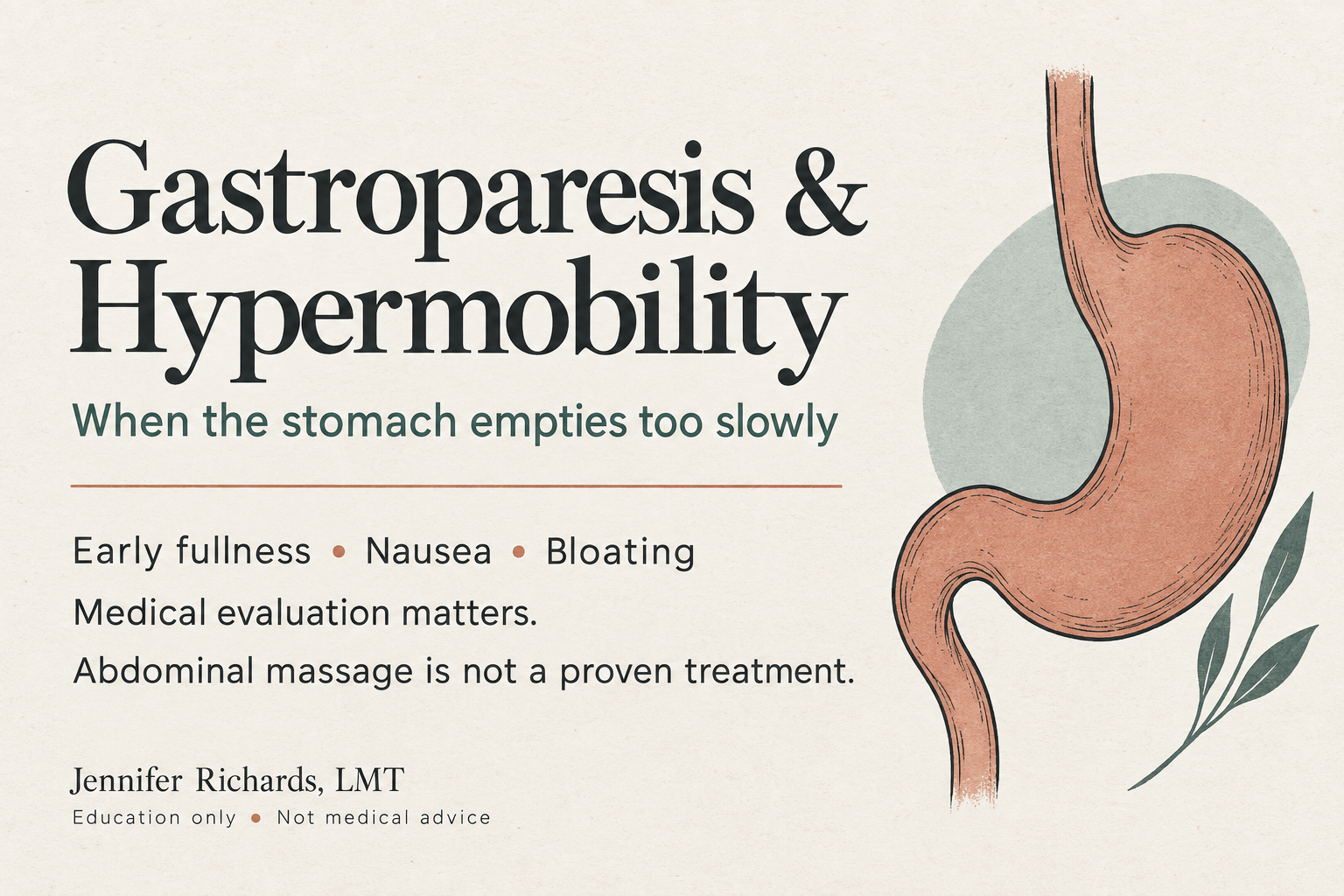
Digestive symptoms can affect how a hypermobile client eats, sleeps, moves, and tolerates a massage session. Gastroparesis is one possible explanation for persistent nausea, prolonged fullness, and vomiting. It needs medical assessment, and abdominal massage should not be presented as a proven treatment.
What is gastroparesis
Gastroparesis means the stomach empties food more slowly than it should, without a physical blockage explaining the delay. The stomach normally mixes food and moves it into the small intestine through coordinated muscle activity. Problems with this coordination can leave food in the stomach longer than expected.
Symptoms include feeling full after a few bites, fullness that persists after meals, nausea, vomiting, bloating, upper abdominal pain, and poor appetite. Some people also experience reflux. Symptoms can fluctuate, and vomiting is not required for the diagnosis. [1,2]
Gastroparesis affects stomach emptying. Constipation concerns stool passage through the bowel. A client can have both, but they are different problems with different treatment needs.
How common is it in hypermobility
There is no reliable percentage that applies to everyone with joint hypermobility, hypermobility spectrum disorder (HSD), or hypermobile Ehlers–Danlos syndrome (hEDS). These groups should not be treated as interchangeable.
A frequently cited retrospective study included 218 patients with hEDS at a tertiary care center. Only 42 underwent motility testing; 18 of those 42, or 42.8%, had gastroparesis. That is 42.8% of the tested subgroup, not all people with hEDS.
Those 18 patients represent approximately 8.3% of the full study cohort, calculated as 18 divided by 218. This also is not a population prevalence estimate: most patients were not tested, and a specialist-center sample may differ substantially from the wider community. [3]
The accurate message is that gastroparesis occurs in some people with hEDS, but its true prevalence across the hypermobile population remains uncertain.
What causes it
Stomach emptying depends on coordinated nerves, smooth muscle, and specialized cells that help organize contractions. In hypermobile populations, the connection between connective tissue differences and digestive dysfunction is still being investigated.
Autonomic dysfunction may contribute in some clients. The autonomic nervous system helps regulate digestion as well as heart rate and blood pressure. POTS can coexist with hEDS; in the study described above, POTS was associated with gastrointestinal dysmotility overall. This association does not establish that POTS caused gastroparesis in each patient. Proposed connective tissue mechanisms also remain incompletely established. [3,4]
Other possible contributors include diabetes, certain operations that injure stomach-related nerves, and some postinfectious illnesses. Sometimes no cause is identified. Opioids and some other medications can slow stomach emptying or worsen symptoms. GLP-1 medicines also delay gastric emptying and should be discussed with the prescribing clinician when symptoms develop. Clients should not stop medication on a massage therapist’s advice. [2,5]
It is misleading to explain all cases as “stretchy stomach tissue” or a vagus nerve that needs to be “released.”
How is it diagnosed
Symptoms alone cannot confirm gastroparesis. Similar symptoms can occur with functional dyspepsia, reflux, medication effects, or other conditions. Functional dyspepsia can cause substantial meal-related distress even when stomach emptying is normal.
Medical assessment must establish delayed gastric emptying and exclude a mechanical obstruction. The 2025 American Gastroenterological Association guideline favors a four-hour gastric emptying test over a two-hour test. The medical team also reviews medications and other factors that can affect the result. [5,6]
Massage therapists cannot diagnose gastroparesis through abdominal palpation.
What treatments can help
Treatment aims to improve symptoms, preserve nutrition and hydration, and address contributing conditions.
Individualized nutrition. Smaller, more frequent meals and foods that are soft, well cooked, blended, or otherwise reduced to small particles may be easier to tolerate. Lower-fat and lower-fiber choices are often recommended, with adjustments for individual tolerance. Some clients tolerate liquid nutrition better than solid food. A registered dietitian can help maintain adequate calories and nutrients while avoiding unnecessary restrictions. [7]
Medication.
Clinicians may use medicines that promote stomach emptying, such as metoclopramide or erythromycin, and medicines to reduce nausea and vomiting. These have different purposes: reducing nausea does not necessarily improve emptying. Metoclopramide carries a boxed warning about tardive dyskinesia, a potentially persistent movement disorder; prescribing decisions require discussion of benefits and risks. [5,8]
Management of related conditions. Diabetes management, medication review, and coordinated care for coexisting problems can matter. Treatment for POTS should not be assumed to cure gastroparesis.
Additional support for severe disease. Some patients need feeding into the small intestine when oral intake is insufficient. Selected patients with persistent symptoms despite treatment may be assessed for procedures such as gastric peroral endoscopic myotomy (G-POEM) or gastric electrical stimulation. These are specialist options rather than routine first-line treatments. [5,8]
Is abdominal massage helpful or harmful
Abdominal massage has evidence for helping constipation in some populations. That evidence does not establish that it treats gastroparesis in clients with hEDS or HSD. Small studies involving other settings, including tube-fed patients, cannot establish effectiveness or safety for this population. [9]
There is insufficient direct evidence to recommend abdominal massage as a treatment for gastroparesis in hypermobile clients. Claims that massage empties the stomach, repairs connective tissue, repositions organs, or restores vagal function go beyond the evidence.
Gentle touch may feel comforting to some clients. Others may experience increased nausea, reflux, pain, or distress when the abdomen is touched or compressed. These responses should guide the session; discomfort is not something to push through.
The following are conservative practice precautions rather than a validated hEDS gastroparesis massage protocol:
● Make abdominal work optional and obtain specific consent.
● Avoid deep pressure, forceful kneading, aggressive shear, or attempts to manipulate internal organs.
● Avoid pressure on a painful, distended, or uncomfortably full abdomen.
● Use supported side-lying or a semi-reclined position if prone positioning or lying flat worsens symptoms.
● Keep any trial brief and stop immediately if symptoms increase.
● Record both immediate tolerance and symptoms reported after the session.
A diagnosis of stable gastroparesis does not automatically rule out massage elsewhere on the body.
When should abdominal massage be avoided
Defer abdominal work and arrange medical assessment when there is new or unexplained abdominal pain, substantial tenderness, active vomiting, or a marked change from the client’s usual symptoms.
Do not massage an abdomen when obstruction, acute inflammation, bleeding, or another abdominal emergency is suspected. Severe pain, a rigid or markedly swollen abdomen, vomiting blood or material resembling coffee grounds, black tarry stools, or distension with inability to pass stool or gas require urgent medical attention. Inability to keep fluids down, fainting, or very little urine can indicate significant dehydration. [2,10]
Recent abdominal surgery, wounds, active bowel inflammation, a known abdominal mass, or a hernia require specific assessment before abdominal work. Avoid direct pressure over feeding tubes, stomas, implanted devices, and their sites; follow the treating team’s instructions. Pregnancy requires a separate prenatal assessment and is outside a routine constipation-massage protocol. Published abdominal massage guidance includes several of these exclusions and precautions. [11]
Unusual tissue fragility, easy bruising, anticoagulant use, or a vascular EDS diagnosis warrants additional individualized assessment. hEDS and vascular EDS have different risk profiles.
Medical approval does not remove the need for informed consent, appropriate training, or ongoing monitoring.
What else should clients and therapists understand
Serious nutrition problems can occur at any body size. Persistent vomiting, reduced intake, or nutritional deficiencies deserve assessment even when a client has not visibly lost weight.
Generic digestive advice can backfire. “Eat more fiber” is common constipation advice, but may worsen tolerance in gastroparesis. A massage therapist should reinforce the client’s individualized medical and dietetic plan.
Hydration difficulties can complicate the session. A client with POTS who struggles to eat or drink may have greater difficulty with position changes. Allow time to sit up and stand, and postpone treatment when the client is acutely unwell.
Symptoms deserve respect. Digestive disorders can disrupt work, social meals, and daily routines. Anxiety may accompany illness, but should not be used to dismiss physical symptoms.
Useful intake questions include: Has gastroparesis been medically confirmed? What symptoms are present today? Which positions worsen nausea or reflux? Are there tubes, devices, hernias, recent operations, or restrictions? Has abdominal touch helped or worsened symptoms previously?
The massage therapist’s role is to offer tolerable, supportive care, recognize changes that need referral, and avoid promising a digestive treatment that the evidence does not support.
Disclaimer
This article provides general education for massage therapists and clients. It is not medical advice and does not diagnose, treat, or replace care from a qualified healthcare professional. Gastroparesis requires medical evaluation and individualized management. Massage is supportive care and has not been established as a treatment for gastroparesis in hEDS or HSD. Abdominal techniques require appropriate training, informed consent, and assessment of individual risks. Seek urgent medical care for severe or rapidly worsening symptoms, suspected bleeding or obstruction, or significant dehydration.
References
1. NIDDK. Definition and Facts for Gastroparesis.
2. NIDDK. Symptoms and Causes of Gastroparesis.
3. Alomari M, et al. (2020). Prevalence and Predictors of Gastrointestinal Dysmotility in Patients with Hypermobile Ehlers-Danlos Syndrome: A Tertiary Care Center Experience. Cureus, 12(4), e7881. doi:10.7759/cureus.7881.
4. Wu W, Ho V. (2024). An overview of Ehlers Danlos syndrome and the link between postural orthostatic tachycardia syndrome and gastrointestinal symptoms with a focus on gastroparesis. Frontiers in Neurology. doi:10.3389/fneur.2024.1379646.
5. Staller K, et al. (2025). AGA Clinical Practice Guideline on Management of Gastroparesis. Gastroenterology, 169(5), 828–861. doi:10.1053/j.gastro.2025.08.004.
6. NIDDK. Diagnosis of Gastroparesis.
7. NIDDK. Eating, Diet, and Nutrition for Gastroparesis.
8. NIDDK. Treatment for Gastroparesis.
9. The Effect of Abdominal Massage on Gastrointestinal Functions: A Systematic Review (2020).
10. NHS. Hernia.
11. Leeds Community Healthcare NHS Trust. Abdominal massage.
Evidence reviewed September 15, 2026.


